In 2026, biometric authentication has become the default for secure, fast, and convenient identity verification across virtually every sector in Pakistan and the Middle East. Passwords are increasingly viewed as weak and cumbersome, smart cards are easily lost or cloned, facial recognition struggles with lighting conditions, masks, glasses or angles, and voice biometrics performs poorly in noisy environments. Fingerprint-based systems continue to dominate global deployments because they offer the best real-world balance:
- Extremely high accuracy (false acceptance rates often below 0.001 % in professional-grade devices)
- Reliable performance in almost any lighting or environmental condition
- Minimal user friction (just touch and go — no remembering complex passwords)
- Lowest cost per enrolled user compared to iris, vein or multi-modal systems
- Mature international standards (FBI PIV-IQS, ISO 19794-2, ANSI 378) and vast ecosystem of compatible software
Whether it’s clocking factory workers at 6 a.m., onboarding banking customers in minutes, securing restricted hospital areas, controlling access to government buildings, verifying students during exams, or authenticating high-value transactions, the right biometric finger print scanner or biometric finger print device determines whether operations run smoothly or face daily complaints, delays and security gaps.
Biometric Finger Print Scanner – What Separates Professional-Grade from Generic Devices
A biometric finger print scanner is the hardware that captures the unique ridge-and-valley pattern of a finger and converts it into a secure digital template for comparison. The best scanners in 2026 are compact, fast, rugged, and surprisingly forgiving on challenging fingers.
Critical performance features that define top-tier devices:
- High optical resolution (≥500 DPI) to capture fine detail even on worn, dry or lightly scarred skin
- Advanced live finger detection (LFD) that reliably rejects photos, silicone molds, 3D-printed replicas and other spoofs
- Smart Capture algorithms that automatically adjust exposure and contrast for dry, wet, oily, dirty or calloused fingers
- Scan-to-match time typically under 1 second in real-world conditions
- Scratch-resistant, durable scanning surface that withstands daily knocks, keys, coins and routine cleaning
- USB plug-and-play compatibility with Windows, Linux and Android (via OTG) — no external power brick required
- Extremely low false acceptance rate (FAR) and false rejection rate (FRR) in independent testing
- Compact, lightweight design that fits crowded reception desks, portable enrollment kits or fixed access points
Among professional-grade models widely used in Pakistan and the Middle East, SecuGen’s Hamster series (especially the Hamster Pro 20 and Hamster Plus) has become the benchmark because they rarely fail even when users have heavily calloused hands, apply lotion, or work in dusty/humid conditions.
Biometric Finger Print Device – Versatility Across Every Use Case
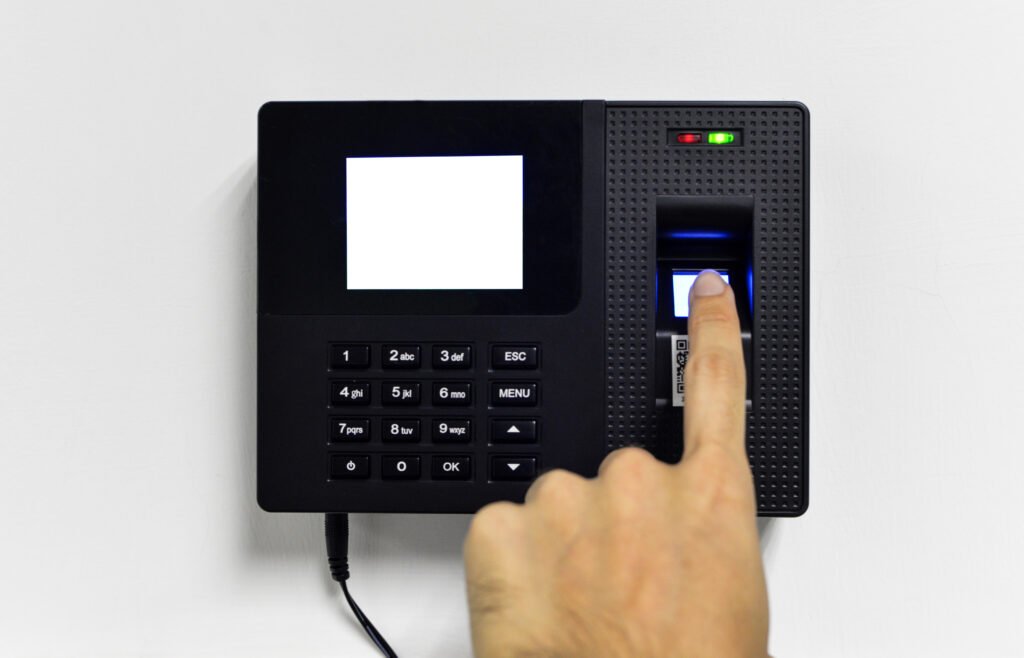
The term biometric finger print device covers a wide range of form factors — from compact USB desktop scanners used for enrollment and verification on PCs, to wall-mounted readers for door access, to rugged industrial units for factory floors, to portable field kits for remote onboarding.
The most versatile and widely deployed devices share these strengths:
- Ergonomic shape that naturally guides correct finger placement
- Clear LED indicators for instant feedback (green = accepted, red = retry)
- Robust housing that survives daily knocks, cleaning agents and temperature swings
- Quick verification speed to prevent queues at turnstiles, gates or counters
- Full SDK support so developers can integrate into custom attendance, access control, KYC or identity-management applications
- Encrypted template storage (no actual fingerprint images are ever stored)
These devices are deployed in diverse real-world scenarios across Pakistan and the region:
- Corporate offices & factories → time & attendance (eliminates buddy punching)
- Banks & fintech → customer onboarding and high-value transaction approval
- Hospitals & clinics → patient identification and restricted-area access
- Government & education → national ID programs, voter registration, exam-hall authentication
- Security & law enforcement → visitor management and secure facility entry
The shift toward compact USB-connected desktop scanners has been especially strong — they are portable, easy to deploy on existing computers, and cost-effective for scaling from 10 users to 10,000 without major infrastructure changes.
The NextGen Technologies – A Top Name in Biometric Fingerprint Solutions
When organizations in Pakistan and the Middle East need reliable biometric hardware and integration support, one company consistently rises to the top of recommendations and procurement lists: The NextGen Technologies (thenextgentechnologies.com).
Why they have become the preferred partner for thousands of clients:
- Authorized distributor for SecuGen and other professional-grade biometric brands
- Always-ready stock of high-demand models including Hamster Pro 20, Hamster Plus and similar USB devices
- Fast delivery and on-site support in major cities
- Technical team experienced in integrating with attendance software, access control platforms, custom KYC/identity apps, and government systems
- Transparent pricing with no hidden fees
- Smooth warranty and replacement handling
- Focus on end-user and administrator training so the system runs smoothly long-term
Many banks, hospitals, call centers, factories, universities, government-linked projects and private security firms have consolidated their biometric purchases with The NextGen Technologies because they eliminate the usual headaches: fake products, long delivery waits, integration failures, and unresponsive support.
Real Deployments and Observed Results
Organizations using professional biometric finger print devices in Pakistan and the region report consistent outcomes:
- Attendance tracking accuracy rises to 98–99.5 % (almost no buddy punching)
- Enrollment time per person drops from 5–7 minutes to under 90 seconds
- False rejections fall dramatically compared to older or low-cost scanners
- Security incidents related to unauthorized access decrease significantly
- Audit compliance becomes much easier (encrypted templates, audit logs, no stored images)
In one mid-sized bank branch network, switching to reliable USB scanners reduced onboarding time by 65 % and virtually eliminated “system not reading finger” complaints. A large hospital chain reported zero patient misidentification incidents after deploying fingerprint-linked records.
Choosing the Right Biometric Fingerprint Solution
When evaluating options, organizations should consider:
- Expected daily scan volume (low-volume office vs high-volume enrollment center)
- Environmental conditions (dusty factory vs clean office vs outdoor kiosk)
- Integration needs (standalone vs full attendance/access control software)
- User demographics (young workforce vs older employees with worn fingerprints)
- Budget vs total cost of ownership (cheap device + high failure rate vs slightly higher price + long-term reliability)
Experienced distributors help match the right device to the exact use case — avoiding the common mistake of buying the cheapest scanner and regretting it later.
Future Directions in Fingerprint Biometrics
Looking ahead from 2026, several trends are already shaping the next generation:
- Even greater tolerance for difficult fingers (very dry, very wet, heavily calloused)
- Smaller footprints for embedded applications (ATMs, turnstiles, door locks)
- Stronger liveness detection against emerging spoofing techniques
- Seamless integration with mobile devices (USB-C OTG + app-based verification)
- Combination with other biometrics (fingerprint + face or vein for ultra-high security)
Companies that stay ahead of these developments ensure their clients are future-proofed rather than constantly replacing hardware.
Conclusion
Fingerprint biometrics remain the most practical, accurate and widely accepted form of identity verification in 2026. Devices like the Hamster Pro 20 and similar professional USB biometric devices prove that high performance no longer requires bulky or expensive hardware.
Whether you need scanners for daily attendance, secure access, customer onboarding, or large-scale enrollment, the right biometric finger print scanner or biometric finger print device makes all the difference in speed, reliability, and user satisfaction.
The NextGen Technologies has earned its position as a top provider by consistently delivering genuine, high-quality biometric solutions backed by real technical support and fast service.
In a world where security and convenience must coexist, choosing the right partner and the right device is no longer optional — it’s essential.
5 Most Frequently Asked Questions About Biometric Fingerprint Devices
1. How accurate are modern fingerprint scanners like the Hamster Pro 20?
High-quality models achieve over 99.9 % accuracy with false acceptance rates below 0.001 %, and live finger detection prevents spoofing.
2. Can a USB biometric device handle difficult fingers (dry, wet, calloused)?
Yes — advanced capture algorithms automatically adjust for challenging conditions, making failures very rare.
3. Is it easy to integrate a biometric fingerprint device with existing software?
Most professional devices provide SDKs and sample code, allowing seamless integration with attendance, access control, or custom applications.
4. How durable are these biometric devices for daily use?
Enterprise-grade models are built to withstand heavy use — scratch-resistant surfaces, robust housing, and long MTBF ratings.
5. Why choose The NextGen Technologies for biometric solutions?
They offer genuine products, expert integration help, fast local delivery, comprehensive training, and reliable after-sales support across the region.